
WASHINGTON, D.C. – Yesterday as Meta was dragged to a federal court by a cadre of state Attorneys General, survivor parents, youth organizers, and safety advocates from California, Colorado, Kentucky, and New Jersey called for accountability for Meta, applauded the Attorneys General for bringing case to trial, and spotlighted evidence proving that CEO Mark Zuckerberg and Meta senior leadership misled the public about its dangerous and addictive platforms. Key clips are below.
Fox News
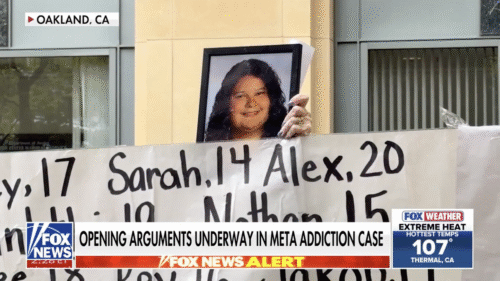
Correspondent: Outside court today, a group of advocates and parents unveiled a banner with the names of nearly 400 children they say died from social media-related harm. Mary Rodee says her 15-year-old son Riley took his own life after meeting a child predator on Facebook.
CNN
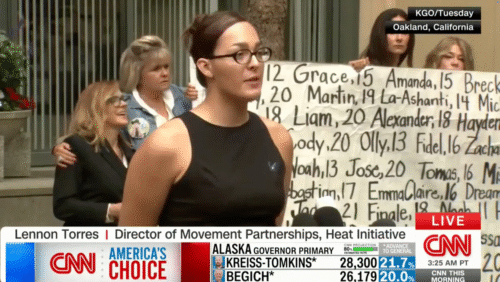
Lennon Torres: CEOs like Mark Zuckerberg and Adam Mosseri would rather make money than protect its users, especially vulnerable children.
Mary Rodee, NY: Meta and others have built empires on exploitation, and they hide behind outdated laws, while families like mine live with the heart consequences.
Julianna Arnold, CA: This list doesn’t even represent the tip of the iceberg for the number of children who have either died or been harmed by social media.
SCRIPPS
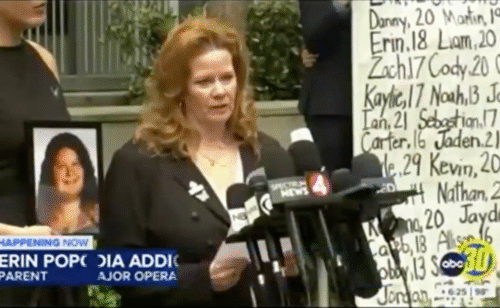
Lori Schott, CO: I’m here today because my daughter should still be alive.
Erin Popolo, NJ: When Emmy died, I knew immediately that this was not just kids being mean. It wasn’t a mystery. It was a design flaw, a system built to maximize engagement, even when that engagement was cruelty, humiliation, and harm.
Correspondent: Inside the court, prosecutors set up their case with opening statements claiming Meta intentionally designed Facebook and Instagram to addict children and teens – telling the eight-person jury the case can be described in four words: “Hook, hold, harvest, and hide.”
CNBC
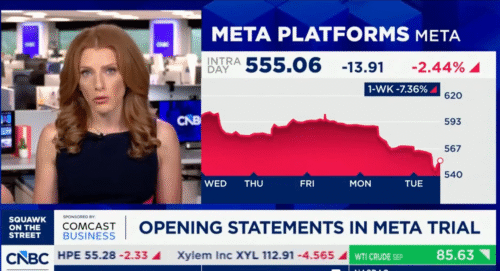
Julia Boorstein: Now, take a look at meta shares. They’re down about 2.5% – down about 28% in the past year.
Anchor: Julia, how should we think about the overall impact because damages and that number is pretty staggering? That’s one thing, but they could also potentially have to change the business model as well, which would impact, you know, future financial picture. Right?
Julia Boorstein: Yes, absolutely. I mean, what is really a question here is whether or not the judge could ask Meta to change his algorithm. There are a couple of specific things in focus, such as the infinite scroll and the targeting of content. That is not necessarily that…I would put it this way, targeting content that’s focused more on engagement than what the state AGs say they would like, which is more on well-being, especially for teens. Now, if you look back at the New Mexico lawsuit, Meta shares actually went up even though New Mexico won certain portions of that, because Meta was not asked to totally wholesale change its algorithm. It was just asked to make certain changes around child safety. So I think there’s a lot of nuance here, and this can turn out in a lot of different ways, but the more Meta is asked to change its algorithm, the worse it is for the company.
Print and digital coverage is below:
Associated Press: In Meta’s trial, families of social media victims see a pivotal moment for online safety
By Kaitlyn Huamani on 8/18/26
As opening statements kicked off Tuesday in a trial for Meta Platforms, advocates and parents of social media victims gathered outside the federal courthouse in Oakland, California, with a banner that stretched several feet across.
Written on it in black ink were the names of children and young adults who have died from social media related harms, including deaths by suicide after bouts of cyberbullying or sextortion. Giovanni, an 11-year-old, Bubba, a 13-year-old, and Englyn, a 14-year-old, were among the nearly 600 names. Parents said the names were “just the tip of the iceberg.”
“Behind us, justice is going to be served,″ said Lennon Torres, an advocate with the organization Heat Initiative. “The courtroom doors are open, and it is time that the public see what the executives at Meta have known all along: that their products are designed to addict and to harm children.″
…
The trial represents a “groundswell of public perception changing against these companies,” said Amy Neville, whose 14-year-old son Alexander Neville died from fentanyl poisoning after being deceived by a drug dealer operating on Snapchat. Neville, like many other parents who have lost their children in similar ways, has dedicated her life to educating and spreading awareness of the dangers of social media.
“If we can keep holding them accountable over and over, something has to give, and I don’t want us to stop doing this until they’ve made their products safe by design,” she said.
Los Angeles Times: ‘The young ones are the best ones’: Meta on trial for alleged effort to hook kids
By Sonja Sharpe on 8/18/26
California launched a salacious opening to its hotly anticipated multistate lawsuit against Meta on Tuesday morning, detailing the tech titan’s focus on its preteen users in language that could have been lifted from Vladimir Nabokov’s “Lolita.”
“You’re going to hear how Meta desperately tried to hold on to those kids, how it wanted them so badly, how it wanted them young,” California Deputy Atty. Gen. Megan O’Neill told the eight-member civil jury in Oakland federal court.
Her voice dripped with innuendo as she read out the title of a company memo: “The young ones are the best ones.”
“You’re going to hear how Meta tried to hook kids under 13, the youngest users,” she said, previewing internal documents that Meta had unsuccessfully fought to keep out of the blockbuster trial’s opening monologue. “They were looking at tweens. Tweens.”
NPR: ‘Meta Hooked Kids’: Federal Trial Against Tech Giant Kicks Off in Oakland
By Katie DeBenedetti and Rachael Myrow on 8/18/26
“Coco was 12 when she opened Instagram for the first time in 2017, four years before the world learned what Meta already knew: Instagram was harming teenage girls,” mom Julianna Arnold said outside the Oakland courtroom. There, advocates gathered to pay tribute to nearly 400 deceased young people who were allegedly lured into sexual exploitation through Facebook, or served content that made them feel worse about themselves and their bodies.
“By her teens, [Coco] could not look away. Her scrolling became depression, then anxiety she couldn’t escape,” Arnold said.
She said her daughter was groomed by a man on Instagram, who sold her what she thought was Percocet, but turned out to be a fatal dose of fentanyl, when she was 17.
“Coco’s story was not an accident. We know it was the predictable outcome of a platform Meta knew harmed children,” Arnold said.
…
“We’re going to make history here,” said Erin Popolo, whose daughter Emily died by suicide after being cyberbullied and harassed. “This is going to be a groundbreaking trial. They’re going to be found liable for what they are doing to people.”